

Flushable Wipes Stuck in Cast Iron Pipes: Causes, Solutions & Prevention
- Home
- Blog Details
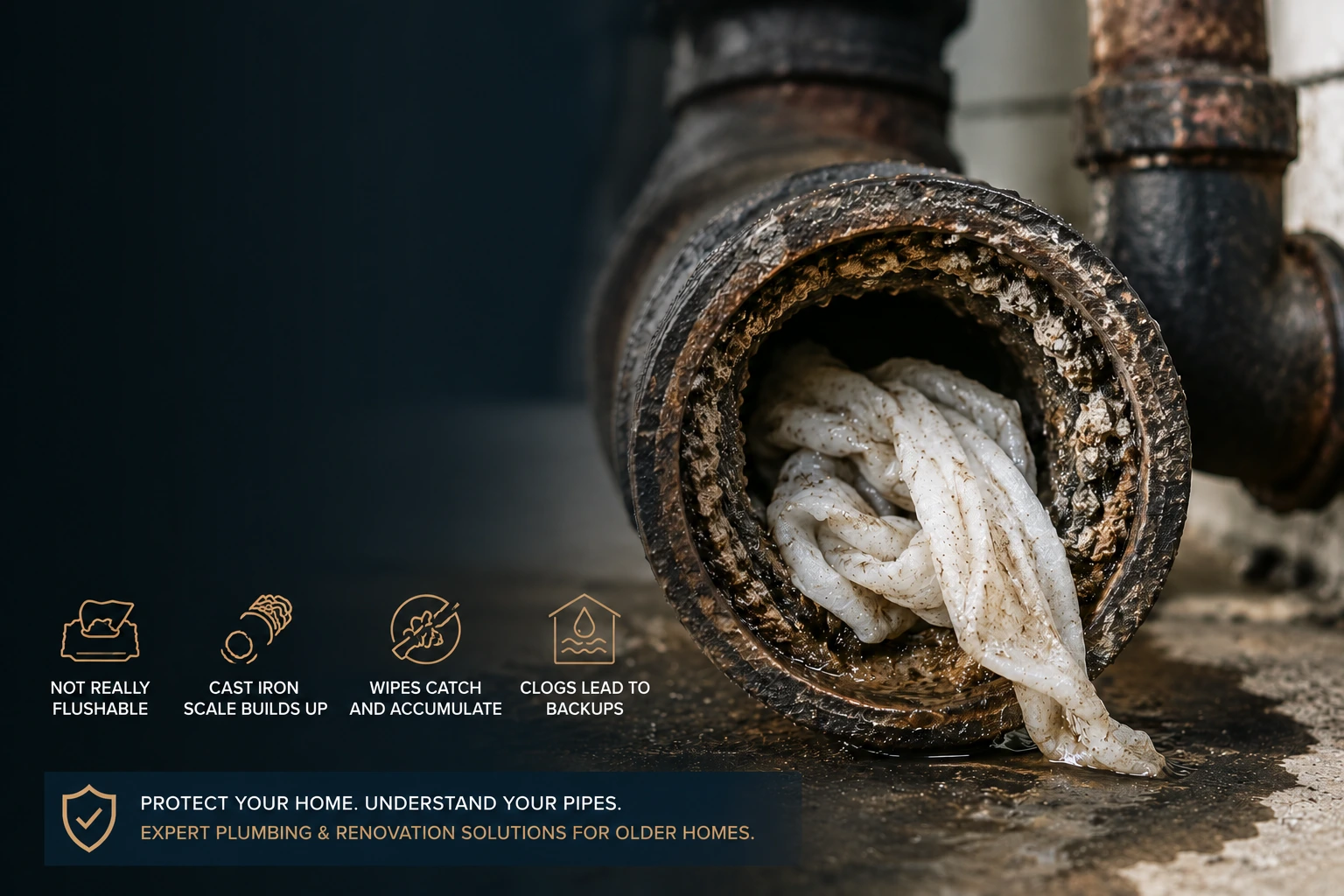
‘Flushable’ wipes are one of the most common causes of plumbing blockages in older homes — and the label is misleading. Despite the name, most wipes don’t break down the way toilet paper does, and in homes with cast iron drain pipes, they’re especially likely to cause serious clogs. Understanding why this happens, what a blockage looks like as it develops, and when the underlying pipe condition — not just the wipes — needs attention, can help you avoid a much larger repair down the road.

Why “Flushable” Wipes Aren’t Actually Flushable
Toilet paper is engineered to fall apart within seconds of contact with water, breaking down into short fibers that move safely through a plumbing system. Most wipes labeled ‘flushable’ are built to resist that kind of breakdown — that’s part of what makes them durable and useful in the first place. They typically clear the toilet bowl without issue, which is often the extent of the testing behind the ‘flushable’ label, but they tend to stay largely intact well after that point, as they travel through the drain line where they can snag on rough surfaces, existing debris, or each other.
What Is Cast Iron Pipe Scale?
Cast iron was the standard material for residential drain lines for much of the 20th century, and as it ages, the interior surface gradually corrodes. This corrosion — often called ‘scale’ — is a rough, flaking buildup of rust and mineral deposits that forms along the inside of the pipe. Rather than a smooth surface, an aging cast iron drain line often has an interior that’s closer to sandpaper, with scale narrowing the pipe’s effective diameter and creating snag points where debris can catch and accumulate. This is the underlying condition that makes older cast iron systems especially prone to wipe-related blockages, even when a household isn’t flushing anything unusual.
Why Cast Iron Pipes Are Especially Vulnerable
Many older homes throughout the Main Line and Philadelphia still have some or all of their original cast iron drainage system. A wipe that might pass through smooth, newer PVC pipe without much issue is far more likely to catch on the rough, scaled interior of aging cast iron. Once a wipe catches on existing scale, it becomes a snag point for the next piece of debris — another wipe, grease, hair — and the blockage builds from there.
How a Wipe Clog Develops Over Time
A single wipe rarely causes an immediate blockage. More often, wipes catch on existing scale buildup inside the pipe, and each subsequent wipe, along with grease, hair, or other debris, adds to that mass. Over weeks or months, this buildup narrows the interior of the pipe further, until water flow becomes restricted or a full blockage forms. This is why a household might flush wipes for months without an obvious problem, then suddenly experience a severe backup — the buildup was happening gradually the entire time.
Signs You May Have a Wipe-Related Blockage
A few signs commonly point to a developing blockage from wipes or similar debris: slow-draining toilets or sinks throughout the house, rather than just one fixture, gurgling sounds from drains when other fixtures are used, and in more advanced cases, sewage backing up into a shower or floor drain — often the lowest drain in the house, since that’s typically where a main line blockage shows up first.
Quick Signs You Should Call a Plumber
✓ Slow drains throughout the house, not just one fixture
✓ Gurgling or bubbling toilets
✓ Sewer odors, particularly in a basement
✓ Water backing up into a shower or floor drain
✓ Multiple fixtures clogging around the same time
Can Flushable Wipes Cause Water Damage?
A blockage caused by wipes doesn’t simply slow drainage. If wastewater can no longer move through the drain system, it may back up into showers, floor drains, or finished basements. In severe cases, repeated backups can damage flooring, drywall, insulation, and framing, making early intervention far less expensive than repairing water damage after the fact.
Clearing a Blockage vs. Addressing the Underlying Pipe Condition
A plumber can typically clear an active wipe clog using a drain snake or hydro-jetting, which removes the immediate blockage and restores flow. However, in homes with significantly corroded cast iron, this often provides only temporary relief — the scale that allowed the clog to form in the first place is still there. A camera inspection can help determine whether the underlying pipe condition is contributing to recurring blockages, and whether descaling or pipe replacement is the more permanent solution.
Can Hydro Jetting Remove Cast Iron Scale?
In many cases, yes. Hydro jetting uses high-pressure water to clear debris and can also break loose scale buildup along the interior of an aging cast iron pipe — a process sometimes called descaling. This is generally more effective at addressing the underlying condition than a standard drain snake, which mainly clears the immediate blockage without addressing the scale that caused it. That said, jetting has limits: if a cast iron pipe has deteriorated significantly — extensive corrosion, cracking, or structural weakness — jetting alone may not resolve the problem, and pipe repair or replacement becomes the more practical long-term solution. A camera inspection before and after jetting helps confirm whether descaling fully addressed the pipe’s condition or whether further work is needed.
Image: Before/after camera inspection following hydro jetting on cast iron drain line
Why Older Pennsylvania Homes Experience This Problem More Often
Homes throughout the Main Line and greater Philadelphia built before the 1970s frequently still have original cast iron drain lines, which means the scale buildup that makes wipe-related blockages more likely has often had decades to develop. This is a common discovery during larger renovation projects — opening up a bathroom or basement often gives the first real look at a drain line’s actual condition after years of gradual deterioration that wasn’t visible from the outside.
Why Older Homes Are More Susceptible
Cast iron was the standard drain pipe material from roughly the 1930s through the 1970s, meaning homes built during this period throughout the Main Line and greater Philadelphia often still have original cast iron drain lines. The longer a cast iron system has been in place, the more time scale buildup has had to develop — homes from the 1930s and 1940s have typically had decades longer for corrosion to accumulate than those built closer to the material’s phase-out in the 1970s.
Why Renovation Is Often the Best Time to Address Aging Cast Iron Pipes
A bathroom renovation, basement remodeling, or whole home renovation is often the most cost-effective time to address aging cast iron plumbing, since walls and floors are already open and accessible. Rather than treating pipe condition as a separate, standalone repair, evaluating and addressing cast iron scale or deterioration during a planned renovation typically avoids the additional cost of opening finished surfaces specifically for plumbing access later.
How to Prevent Future Blockages
The most effective prevention is straightforward: avoid flushing anything other than toilet paper, including wipes labeled ‘flushable,’ paper towels, and hygiene products, which are all more likely to catch on aging pipe surfaces than toilet paper. For homes with known cast iron drain lines, periodic camera inspections can also help catch developing scale buildup before it causes a full blockage, allowing descaling or maintenance to be scheduled rather than dealing with an emergency backup.
| Factor | Cast Iron | PVC |
|---|---|---|
| Interior Surface | Rough, scaled with age | Smooth |
| Corrosion | High | None |
| Scale Buildup | Yes | No |
| Wipes Catch Easily | Yes | Rarely |
| Hydro Jetting | Often needed for descaling | Rarely needed |
| Typical Age in Homes | Pre-1970s construction | Modern replacements |
Frequently Asked Questions
Despite the label, most products marketed as ‘flushable’ wipes are not engineered to break down the way toilet paper does. They may clear the toilet trap, but they often remain largely intact as they travel through the drain line, where they can snag on rough surfaces—particularly in older cast iron pipes—and cause significant blockages.
Cast iron drain lines are common in homes built before the early 1970s. You can often see them in an unfinished basement or utility room—cast iron pipe is dark gray to black, heavier than plastic, and connects with rubber or lead-caulked joints. A licensed plumber can confirm pipe material with a camera inspection if access is limited.
Chemical drain cleaners are generally not effective against wipe-related blockages. Unlike organic matter, wipes don’t break down in chemical solutions. A drain snake or hydro-jetting by a licensed plumber is the appropriate approach for clearing a wipe clog and addressing the scale buildup that may have contributed to it.
Hydro jetting is generally safe for cast iron pipe in reasonably good structural condition. However, if a pipe is already severely corroded, cracked, or compromised, high-pressure jetting can accelerate damage. A camera inspection before jetting helps a plumber assess whether the pipe is suitable for the procedure or whether repair or replacement is the better path.
Replacement is typically recommended when camera inspection reveals severe corrosion, cracking, or structural failure—conditions where cleaning or descaling would only provide short-term relief. If significant sections of cast iron pipe show advanced deterioration, partial or full replacement is generally the more cost-effective long-term solution, particularly when paired with a planned renovation.
Costs vary depending on the length of pipe affected and the severity of the scale buildup. A camera inspection typically precedes descaling work to assess the full scope before providing an estimate.
Yes. A sewer camera inspection allows a plumber to see the interior condition of the pipe directly, confirming the presence and severity of scale buildup rather than relying on symptoms alone.
Related Services
Related Articles
Share :